Joy as the Keeper of Stories
I noticed my noticing, and I gave myself a moment to wonder what unexamined assumptions were traveling with me that day.
I took of my two classes on a field trip to tour the world of The Hotel on the Corner of Bitter and Sweet. We wanted to see Nihonmachi and The Panama Hotel, we wanted to picture the street Henry raced down on his Red Flyer as he escaped with of Keiko’s family pictures. We wanted to visualize the vibrancy of the community. And, my history class came along for the ride to touch the places where the events they had just read about actually happened.
I heard from the parents that the kids were nervous about coming into the city. Wasn’t it dangerous, weren’t there lots of homeless people? It was dirty, it was big, it was scary. This is how my last class responded, especially as we were closer to Black Lives Matter protests and the aftereffects of COVID on the downtown area. The mom and I looked at each other in anticipation of what our suburban kids (and we) were about to experience in the hands of a competent tour guide who loves Seattle, and knows the stories, because Seattle is her home.
In The Hotel on the Corner of Bitter and Sweet Nihonmachi is a community of 72 city blocks filled with businesses, culture, shopping and the vibrancy of thriving neighborhoods. It was the 1930-40’s and the pictures of the time have streets lined with cars, and the paintings show colorful architecture, and tree-filled avenues. Today Japantown of the China International District (CID) is a mere 6 blocks, and the CID is often in the news for unsavory reasons.
I parked up by Kobe Park and *did* walk on the other side of the road because I was uncomfortable walking past the man down at the street corner. That uncomfort was both years of safety awareness as a woman, and unfamiliarity with people unlike me. I noticed litter. I noticed shops boarded up. I noticed the marks of age that don’t show up in the newer, and richer, places of the eastside suburbs. I noticed my noticing, and I gave myself a moment to wonder what unexamined assumptions were traveling with me that day.
The tour started in the theater where a large scrim hung across the stage. The lettering was in Japanese, and each box stood alone in its message. This large canvas curtain had been found in a basement decades after the Japanese incarceration of WW2. It was the advertising screen for the Nippon Kan Theatre, one of the few places where unsegregated events were held in the early 20th century. Two of the businesses advertised on the scrim were still operating: the five and dime store and a restaurant.
Doan, our guide and a second-generation refugee from Viet Nam, took us out onto the street. She greeted the people who walked past by name and could tell us about any building that we walked by. She made us look up, she asked us to look down, making sure we were observing the touchpoints of the neighborhood and the call backs to the book. She pointed to the boarded-up buildings sharing how this had happened twice, once when the Japanese were removed due to executive order 9066 after the bombing on Pearl Harbor, and again during COVID. Her connection of the two events gave a new poignancy to what I was seeing. She stopped us by a yellow mural of Bruce Lee and Kareem Abdul-Jabbar. I’ll be honest and say, I could have easily walked past it. It was done on plywood, and the plexi-glass over it was broken. I'm sad to admit that my eastside sensibilities missed all the cultural clues.
This board was placed over a window to protect the oldest Chinese restaurant in Seattle, the Tai Tung. During COVID artists had created murals on the boarded-up businesses so they didn’t look desolate, didn’t flash people back to another time of trauma, but instead created resiliency. The mural of Lee and Abdul-Jabbar symbolized the unity between the Black and Asian communities (also a touch point in Bitter and Sweet). In 2022 someone stole the Bruce Lee half of the mural. In 12 days the artists had repainted and rehung Lee’s portrait. They weren’t letting miscreants define their community.
Doan led us to an alley, fully acknowledging the reputation of alleyways. But the community has reclaimed this place, too. They had hung interpretive signs explaining Nihonmachi, with pictures of sketches from the time, capturing it essence. On the other side was a picture of Minidoka, the Japanese internment camp in Idaho (where Henry traveled to find Keiko). There was also a picture of a young Japanese woman, dressed to the nines, holding her toddler, a clasp purse and a teddy bear held in a free hand. My students called her face determine. I saw layers of pain. She came through the internment and in her 70’s spoke out against what fear was creating in our nation after 9/11.
Up the alleyway was a gated park, strung with paper cranes. Once again vandals had painted over the pictures of Nihonmachi, and the cranes were a reminder of life. The community had cleaned up the pictures within 24 hours and brought their own art to counter destruction. Behind the gate was another story of resilience.
Remember the screen in the theater, and I said that some of the businesses were still operational? That story was inside this gate.
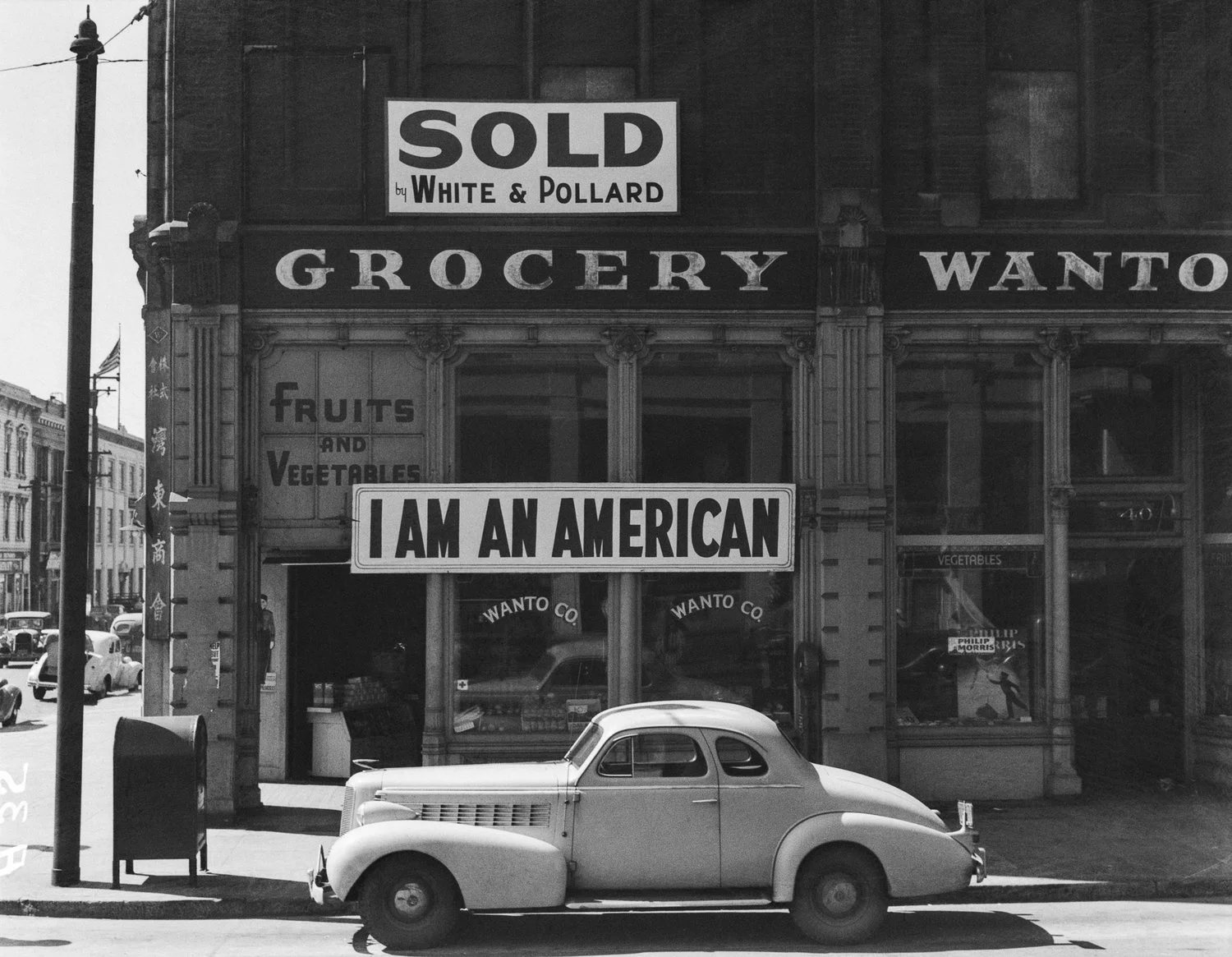
A businessman and his family owned a five and dime store and was established in the community. He was exactly what Dorothea Lange’s photograph, “I am an America,” embodied. Just like the business owner in Lange’s California picture, he was incarcerated during the war, leaving his business to the winds of greed and opportunist men. However, here in Seattle the landlords were good men. Two Jewish brothers guarded the business, guarded the house, and paid the dues so the bank couldn’t repossess the store. When the business owner was released, he took the crowbar he had smuggled into Minidoka and pried the boards off of his windows and opened his business again. Unfortunately, the years of incarceration had done their work, and he died of a heart attack within two week, leaving his business to two of his daughters. The women kept the store running (which has to be a whole story in and of itself) and it is now in the hands of cousins, and still in the family. (Let’s say its merchandise is no longer five and dime.)
We ended the tour at another door that was filled with cranes. Cranes had been there two years ago with I last did this tour, and I asked Doan to tell the story, because I couldn’t remember the details, just that it really mattered. And she talked about Donnie Chin, whom she called CID’s Batman. He knew CID, he knew the people, he wouldn’t have walked down the other side of the street like I did at the sight of man, because he would have known the man’s name and known how to connect with his humanity. He fought for his part of the city to make sure it was seen and cared for.
He was killed in 2015. His case has been put aside, never closed, and never resolved. It stands as a symbol for how the CID feels they are seen and treated as a neighborhood in Seattle, not worth the time and effort. So the people make cranes, even 10 years later, to pique the curiosity of those of us who come by and ask, to remind each other that they still remember, and to honor a man who honored them.
The students and I ended our day at Tai Tung with more food than we could eat. As is our custom in class, I asked them, “What is something you can’t let go of?” And they offered pieces of information befitting to their personalities. There were TANKS in Seattle?! Jewish Americans protected the Japanese American. That people owned a building together so rent was affordable. And, of course they turned in on me, “Mrs. Lee, what can’t you let go of?”
I can’t let go of the tight knit place inside a great big city. A place where no one is faceless. A place where community creates art, scrubs away hate, protects each other. I wondered what is my community that I know as well as Doan knows hers. I wonder what stories I am a keeper of that need to be told so we don’t forget. I wonder, again, what joy do I bring to the world so that we can face the ugly that still comes our way. I am inspired by how people on the other side of the lake have been holding their own joy for decades. There is much to learn from their resilience.