Joy as Ritual
Today is the second Sunday in Advent, the Sunday of Peace. Peace conjures images of candlelight and well-being, where all is calm and all is right. In Hebrew the word for peace is Shalom. While I’m no Jewish scholar, my understanding is that shalom has a much deeper meaning than a simple kumbaya. It holds the promise, the blessing, of restoration. Shalom says, “May all be made well, restored to the Goodness, the fullness, of God’s design.” I picture the Garden of Eden, where God walks past new-made Creation and says, “It is good.” Shalom.
We sit in the dark of these months and this week offers us a moment to reflect on the fullness that our traditions around Christmas point to. As I decorated last week the boys schlepped the Christmas boxes from the garage, brought the tree in, placing it on the stand while I slept, and offered a worried hand when I was standing on a barstool in the middle of the dining room hanging thing from the ceiling. But, being them, no one has said a word about how the house looks now, it’s not their thing (this is where I miss my girls). But I’m learning that decorations and beauty is my thing. I need it. But it comes to me that when I don’t need it anymore, I can let it go without the guilt of letting someone else down. And yet. . .
There is nostalgia in these traditions of the Yellow House. They can be reminders of Shalom, if I pause and let the ritual, the ceremony of the season speak to the tradition that was established over time to remind me of our participation in restoration. The electronic water monitor Eric built to let us know when the tree is dry beeped twice a day when we first put that evergreen up. So twice a day I had a pitcher of water in hand, and I was on my knees offering it to the thirsty. The Christmas plates make me feel like a little girl playing house, but they are there to keep my table welcoming, and maybe to remind me to make sure I let others invite me to their table and honor what they are keeping alive. On our table sit candles, a tip to the sacredness of the season, and they drip in an unsacred way. This year, while they offer warm light in the dark days, the wax puddles remind me that I live in a body that has needs and is deserving of care and recognition, and that it too, is sacred in its mess.
This week a little girl came over, and, amid the hubbub of Yellow House chaos, she grabbed her Daddy’s hand and took him to the tree. She stood underneath it for a solid 15 minutes marveling at the ornaments, asking to touch, giving names. No one in the house had commented on the tree, but to her it was a novel delight. I was amazed at how much her wonder restored my heart. It was a gift of Shalom, given by a two-year-old child.
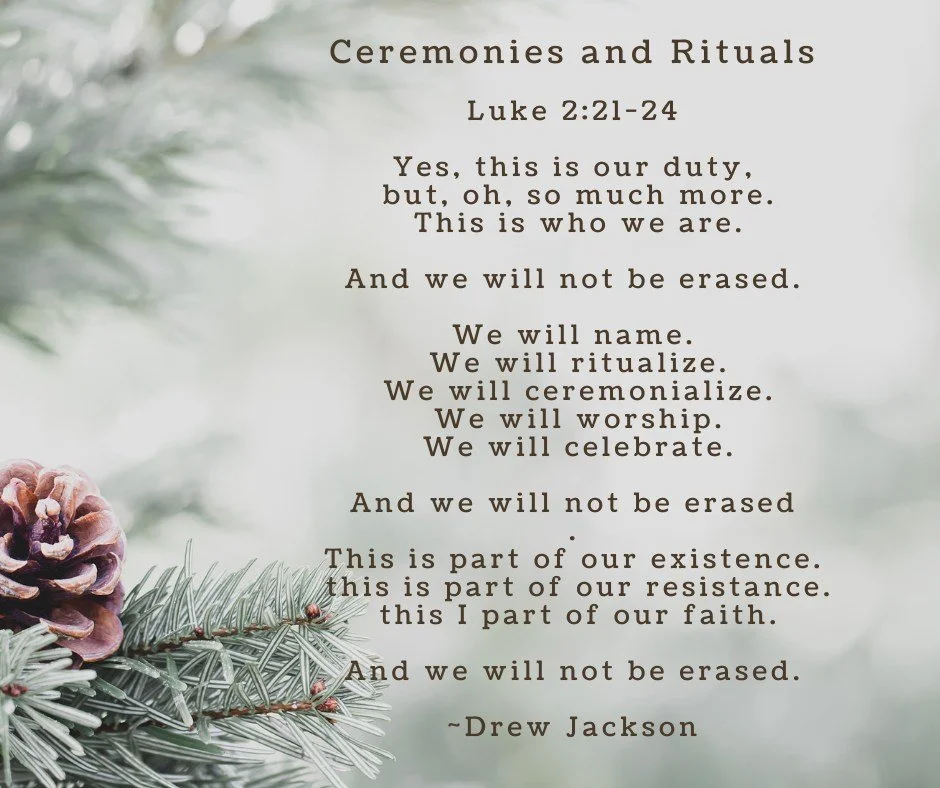
When I read Drew Jackson’s words above, I think of the many cultures and their rituals that speak to Shalom, rituals that keep those cultures from being erased, and the onerous bits of my holiday celebration break free into an offering. I don’t know what traditions I will keep and which ones I will let go, I suppose it depends on which ones keep Shalom alive. When the empty search for nostalgia gets in the way of the essence these traditions were created to pass down, I guess I’ll step back and ask, “What is good?” I will remind myself to find the wonder in momentary offerings and let it call to the restoration of a world in need of a garden.